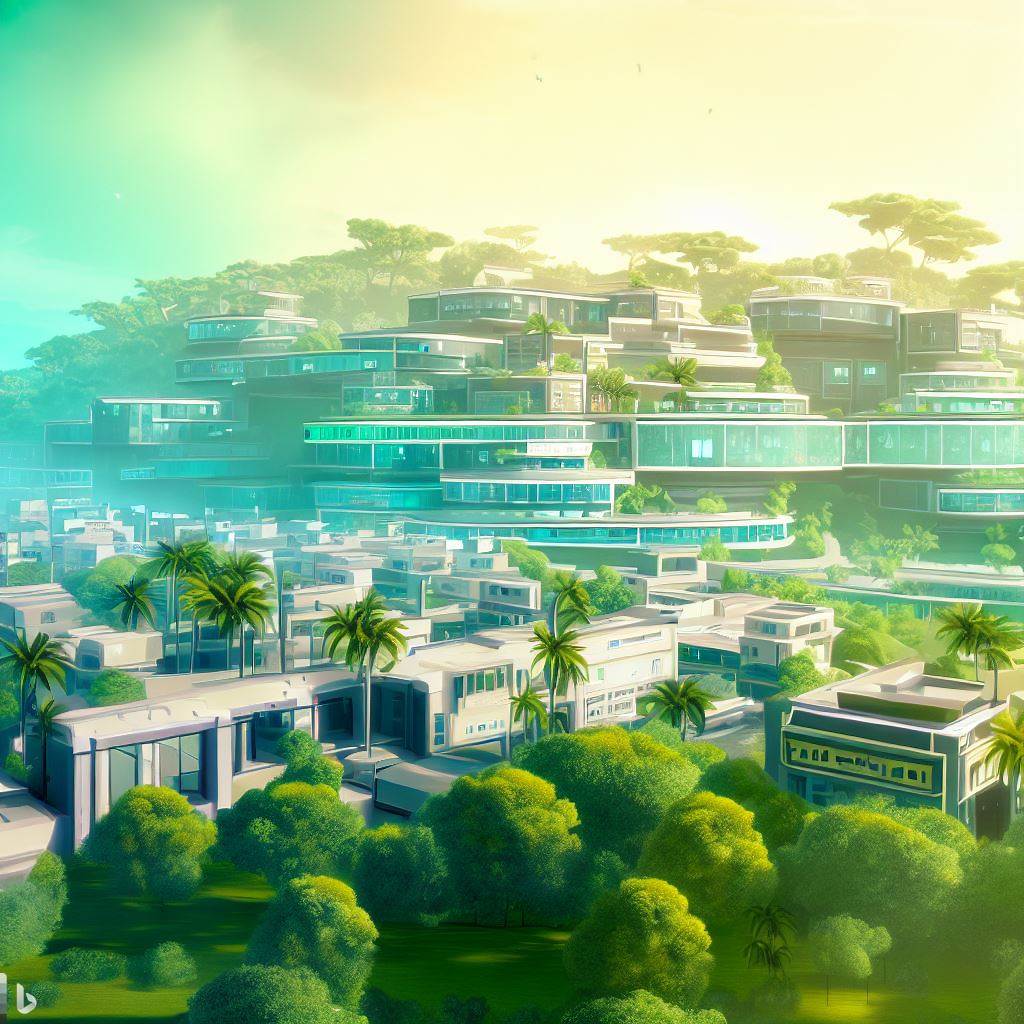
Vision
Our vision is to establish an AI-powered school district that inculcates a holistic and technology-driven educational experience for students of all ages by creating a small metropolis focused on nurturing well-rounded individuals for the ever-changing 21st-century world.
Mission
To develop a technologically advanced educational environment where students can engage in the diverse learning opportunities provided to create meaningful connections, experience innovation, and reach their full potential.
Overview
The AI-Enhanced School District (AESD) will be a small metropolis encompassing various specialized institutions that will integrate artificial intelligence into the fabric of learning, driven by a centralized network system, giving students and educators access to personalized and efficient education, and cultivating a growth mindset.
Key Components:
1. Central AI Control Center
The heart of this educational metropolis will be the Central AI Control Center, responsible for coordinating and managing various AI-driven educational systems, programs, and experiences throughout the district to ensure smooth collaboration and access to resources.
2. Educational Facilities
a. Traditional K-12 Schools: AESD will comprise a series of K-12 schools that incorporate AI in the curriculum and instructional methodologies.
b. Specialized Learning Institutes: Supplementary institutions will focus on specific fields such as arts, sciences, technology, and sports.
c. AI-Assisted Tutoring Centers: These centers will focus on providing personalized learning pathways for each student.
d. Adult Learning and Vocational Training Centers: Lifelong learning opportunities and upskilling courses will be available for the community.
3. Research and Development Institute: This institution will continually study the latest advancements in education and AI to develop innovative solutions to serve the district’s needs.
4. Community Integration: Community centers and public spaces will encourage citizens to participate in the decision-making process, leading to an inclusive and collaborative atmosphere.
5. Sustainability and Green Technologies: AESD will prioritize environment-friendly practices, technologies, and designs in its infrastructure to establish a sustainable metropolis.
Educational Strategies
Personalized Instruction
AI will assist teachers in providing individualized learning experiences tailored to each student’s needs, preferences, and learning styles.
Integrated AI-Assisted Educational Strategy for Personalized Instruction in Science, Technology, Art, and Sports
This educational strategy harnesses the power of AI, which will assist teachers in providing individualized learning experiences tailored to each student’s needs, preferences, and learning styles. The comprehensive framework outlined below will consist of science, technology, art, and sports programs designed to enhance personalized instruction.
Understanding individual needs and preferences
– Assess students’ learning styles, interests, and abilities using AI-powered diagnostic tools and entry assessments.
– Create comprehensive learner profiles to design targeted educational approaches that address specific individual needs.
– Involve students in setting their own educational goals and creating personal learning plans, which fosters a sense of ownership in their education.
Science Program
– Utilize AI-powered interactive simulations and virtual labs for hands-on experiences, allowing students to explore scientific concepts at their own pace.
– Implement project-based learning for real-world applications and connections.
– Develop cross-curricular collaborations that integrate other subjects, such as technology, art, or sports, for a holistic understanding of science.
Technology Program
– Incorporate programming, coding, and robotics into the curriculum, using AI for individualized instruction, adaptive learning, and real-time feedback.
– Foster digital literacy by teaching students to critically evaluate and ethically use digital media.
– Encourage participatory learning by utilizing online forums, wikis, and collaborative platforms for sharing ideas and resources.
Art Program
– Implement a blend of traditional and digital art mediums, including drawing, painting, sculpting, photography, videography, and graphic design.
– Use AI-generated artistic prompts and adaptive learning tools to guide students in developing their unique artistic expression.
– Encourage interdisciplinary experiences by integrating arts with other subjects, like science, technology, and sports, to create innovative projects that emphasize the interconnectedness of disciplines.
Sports Program
– Integrate AI-enhanced monitoring devices and wearables to track individual performance, measure progress and suggest tailored workouts for each student.
– Use AI-powered analytics to identify strengths and weaknesses, to provide personalized coaching and feedback, and reduce the risk of injury.
– Facilitate intramural and extracurricular programs that promote physical, mental, and social well-being, as well as developing teamwork and leadership skills.
Ongoing AI-Assisted Evaluation and Feedback
– Employ AI-driven formative and summative assessments to provide personalized feedback, monitor progress, and adapt instruction as needed.
– Allow teachers to focus more on individual student engagement and fostering meaningful learning experiences by reducing administrative work and automating data analysis.
– Encourage an ongoing growth mindset among students by providing AI-generated feedback that highlights areas for improvement and celebrates achievements.
Professional Development and Collaboration
– Offer extensive professional development programs for educators in leveraging AI technology for personalized instruction.
– Foster a culture of innovation and collaboration among the faculty, with a specific focus on sharing best practices and resources for an integrated educational framework.
The utilization of AI for personalized instruction in this integrated educational strategy ensures each student receives targeted support and enrichment opportunities across science, technology, art, and sports programs.
Real-Time Assessment and Feedback AI Program
The Real-Time Assessment and Feedback AI program is designed to revolutionize education by providing students, teachers, and educational institutions with a comprehensive assessment tool. Through AI analysis of academic progress, the program identifies students’ strengths, weaknesses, and areas of opportunity, while offering personalized feedback to guide their improvement. This plan details the process for designing, developing, and implementing this AI-powered assessment tool.
Real-Time Assessment and Feedback: AI-powered assessment tools will analyze students’ academic progress, identifying their strengths, weaknesses, and areas of opportunity.
II. Objectives
1. Develop an AI-driven real-time assessment and feedback system to enhance students’ learning experiences, tailored to individual needs.
2. Empower teachers and educational institutions with data-driven insights to improve curriculum design and teaching methods.
3. Deploy a secure, user-friendly platform that protects user data and ensures the privacy of all stakeholders.
III. Market Analysis
1. Identify relevant application areas for the AI program, such as K-12 education, higher education, professional development, and corporate e-learning.
2. Study existing assessment and feedback tools to understand strengths, weaknesses, and opportunities for improvement.
3. Determine potential customers and target market segments, such as educators, schools, universities, and corporations.
4. Conduct interviews or surveys with stakeholders to identify their pain points, goals, and expectations.
IV. Required Resources
1. Technical expertise:
a. AI/ML Researchers and Engineers
b. Curriculum developers and assessment specialists
c. Software developers (front-end and back-end)
d. UX/UI designers
e. Data security and privacy professionals
2. Financial resources for development and deployment.
3. Project management team.
V. Development Process
Data Acquisition
a. Collaborate with educational institutions to gather historical assessment data.
b. Use a diverse range of sources to ensure inclusivity across various learning styles, backgrounds, and academic levels.
Feature Selection
a. Identify relevant features, such as grades, test scores, assignment completion, and engagement measures.
b. Use natural language processing (NLP) techniques for qualitative feedback analysis.
Model Development
a. Select appropriate machine learning algorithms for progress analysis, such as regression models or neural networks.
b. Train the AI with historical assessment data, continuously refining it to improve accuracy.
Feedback Generation
a. Design algorithms for personalized feedback, including automated qualitative insights and targeted suggestions based on best educational practices.
b. Integrate human-in-the-loop feedback mechanisms to ensure accuracy, relevance, and effectiveness.
Platform Development
a. Develop a secure, user-friendly web-based interface and native mobile applications for iOS and Android.
b. Design and implement various modules, such as student profiles, assessments, dashboards, real-time analytics, and communication tools.
Integration
a. Enable seamless integration with existing learning management systems and other educational platforms.
b. Create APIs for third-party developers and publishers.
VI. Testing and Validation
Pilot Testing
a. Collaborate with selected educational institutions to conduct pilot tests.
b. Monitor the system’s performance, collect feedback, and identify areas for improvement.
Validation
a. Assess the AI’s accuracy and effectiveness in identifying students’ strengths, weaknesses, and areas of opportunity.
b. Validate the success of personalized feedback in improving learning outcomes.
Refinement
a. Iterate and fine-tune the system based on findings from pilot testing and validation.
VII. Launch and Deployment
1.Develop a comprehensive launch strategy, including marketing campaigns and promotional materials targeted at key stakeholders.
2. Offer training and support resources for users to ensure a smooth transition and effective utilization.
3. Deploy the program in phases, targeting specific markets and expanding based on feedback and results.
4. Monitor and maintain the system, addressing technical issues and integrating necessary feature updates.
VIII. Continuous Improvement
1. Establish feedback loops with customers and users to refine the system post-launch.
2. Update algorithms and incorporate new advancements in AI and NLP research to stay ahead of the competition.
3. Regularly review and optimize the platform’s features based on user needs and technological innovations.
3. Project-Based Learning: AESD will emphasize project-based learning, which blends collaboration, critical thinking, and problem-solving with the support of AI tools to provide an engaging experience.
AESD Project-Based Learning Curriculum
I. Executive Summary
The proposed AESD curriculum will be designed to incorporate project-based learning, focusing on the development of soft skills, critical thinking, problem-solving, and collaboration, while utilizing AI tools to support and enhance the learning process. The curriculum will be tailored to provide an engaging educational experience and promote lifelong learning in the 21st century.
II. Curriculum Goals
1. Develop student autonomy and self-directed learning.
2. Provide an engaging and intellectually stimulating environment.
3. Encourage collaboration, critical thinking, and problem-solving.
4. Leverage AI tools to support and enhance learning outcomes.
5. Foster a deep understanding of subject matter.
6. Promote life-long learning and practical application of learned concepts.
III. Curriculum Components
A. Content Areas
1. Core Subjects: Mathematics, Science, Language Arts, Social Studies
2. Specialization Tracks: STEM, Arts, Business, Humanities
3. Electives: Technology, Foreign Languages, Health and Wellness, Real-world Problem Solving
B. Phases of Project-Based Learning
1. Project Initiation: Identifying relevant subjects and establishing goals
2. Project Planning: Designing the project and setting milestones
3. Project Execution: Implementing the plan and monitoring progress
4. Project Closure: Presenting results and reflecting on the learning process
IV. Methodology
A. Problem-Based Approach: Students will be presented with real-world problems or case studies to explore and solve.
B. Collaborative Learning: Students will work in diverse, cross-functional teams to optimize skills, knowledge, and perspectives.
C. Mentorship and Coaching: Affiliation with experts or industry professionals to provide guidance and real-world knowledge transfer.
D. AI Tools: Implementation of AI-driven analytics, adaptive learning platforms, and AI-enabled study materials to support learning and instruction.
V. Curriculum Implementation Plan
A. Adopt a Framework: Utilize a recognized project-based learning methodology (such as PBLWorks) as the foundation for planning and designing the AESD curriculum.
B. Training: Provide professional development and training for teachers on key aspects of project-based learning, collaboration techniques, and AI tool integration.
C. Project Development: Collaborate with teachers to develop project-based learning modules and assessments aligned with curriculum goals.
D. Incorporate AI Tools: Select appropriate AI tools and technologies directly tied to curriculum goals, with an emphasis on enhancing student learning experiences.
E. Assessment Strategy: Design authentic, performance-based assessments that measure student progress against curriculum objectives.
F. Feedback and Improvement: Continuously evaluate curriculum effectiveness and adjust as needed, based on feedback from students, staff, and other stakeholders.
VI. Resources
A. Funding: Secure funding sources for technology, professional development, and mentorship partnerships.
B. Partnerships: Establish industry and community alliances to create relevant, meaningful learning experiences.
C. Teacher Support: Provide ample resources for teacher success, including lesson plans, materials, coaching, and technology access.
VII. Timeline
1. Year 1: Curriculum development, teacher training, and establishment of partnerships
2. Year 2: Pilot program and curriculum adjustments based on feedback
3. Year 3: Full implementation and ongoing assessment
4. Year 4: Continuous improvement and expansion of the project-based learning curriculum
VIII. Evaluation
An ongoing evaluation process will assess the effectiveness of the AESD project-based learning curriculum based on student performance, engagement, soft skill development, and mastery of content knowledge. By measuring and analyzing these variables, AESD can continuously refine the curriculum to ensure an engaging, relevant, and meaningful education experience for all students.
4. Learning Beyond the Classroom: Virtual reality and AI-driven immersive experiences will allow students to explore scenarios related to subjects being studied in the classroom.
Title: Learning Beyond the Classroom Program: Virtual Reality and AI-driven Immersive Experiences
Objective: To enhance student learning and engagement through virtual reality (VR) and AI-driven immersive experiences that complement and expand upon traditional classroom education.
Program Structure:
1. Needs Analysis
a. Identify subjects and topics suitable for VR and AI-driven immersive experiences.
b. Assess student needs and preferences for VR and AI-driven experiences.
c. Analyze necessary resources, potential partnerships, staff training requirements, and budget constraints.
2. Curriculum Development
a. Collaborate with subject-matter experts, educators, and instructional designers to create a suitable curriculum.
b. Develop detailed lesson plans and learning objectives for each VR and AI-driven immersive experience.
c. Ensure alignment with national or regional curriculum standards and learning outcomes.
3. Content and Platform Selection
a. Research and identify appropriate VR and AI-driven platforms, software, and tools aligned with the curriculum.
b. Curate or develop relevant content and resources, such as simulations, interactive scenarios, or 3D models.
c. Evaluate the quality, effectiveness, and customization capabilities of selected content and platforms.
4. Implementation
a. Provide training and support to staff, including teachers, technicians, and administrators.
b. Establish partnerships with VR and AI content providers, education technology companies, or local businesses.
c. Set up and maintain necessary hardware and software, ensuring adequate Internet connectivity and system compatibility.
d. Develop a timetable and schedule rotations for students to access and participate in the program.
5. Integration with Classroom Instruction
a. Encourage teachers to integrate VR and AI-driven immersive experiences into their lesson plans, assignments, and assessments.
b. Promote collaborative learning through group work, discussions, and VR or AI-driven projects.
c. Use VR and AI-driven experiences to facilitate connections between complementary subjects, such as history and geography, or math and physics.
6. Evaluation and Continuous Improvement
a. Monitor and evaluate student progress, engagement, and outcomes through assessments, quizzes, or assignments related to VR and AI-driven experiences.
b. Gather feedback from students, staff, and stakeholders to identify areas for improvement in the curriculum or the implementation of the program.
c. Continuously refine the program based on feedback, emerging research, and best practices to ensure educational effectiveness.
5. Teacher Professional Development: The district will harness AI to support ongoing professional development for educators, enabling them to stay informed about the latest advancements and best practices.
7. Safety and Privacy
a. Establish and implement safety guidelines and procedures for using VR and AI-driven immersive experiences.
b. Protect student data privacy by complying with relevant regulations and practices when collecting, storing, and sharing data.
8. Outreach and Promotion
a. Communicate program goals, benefits, and achievements with students, parents, staff, and community members.
b. Celebrate successes by showcasing student work and hosting events or workshops related to the program.
c. Seek grants or funding opportunities to ensure program sustainability and expansion.
AI-Enhanced Teacher Professional Development Program
Program Objective:
The primary objective of this Teacher Professional Development program is to integrate Artificial Intelligence (AI) technologies and methodologies to support teachers in staying up-to-date with the latest advancements and best practices in education.
Program Duration: Ongoing
Target audience: Educators of all subject areas and grade levels in the district
I. Program Development
1. Assembling a project team:
a. District IT staff and curriculum leaders
b. Representative teachers from various subjects
c. Outside AI experts or consultants
d. School administrators
2. Conducting a needs assessment:
a. Identifying areas where AI can assist educators in professional development
b. Prioritizing skills and knowledge educators need to maintain
c. Evaluating technological infrastructure in schools and district
3. Defining program goals and objectives:
a. Identifying short-term and long-term outcomes
b. Defining program success indicators
c. Establishing timelines
4. Researching and procuring AI technologies and tools:
a. Reviewing suitable AI platforms (e.g., personalized learning systems, content curation tools, data analysis tools)
b. Evaluating the relevance and compatibility of selected platforms with the district’s curriculum, policies, teaching practices, and technological infrastructure
5. Developing program content and materials:
a. Designing interactive online training modules
b. Developing in-person workshops or seminars
c. Collaborating with AI experts and consultants to create professional development materials
d. Compiling supplemental resources (articles, videos, case studies, etc.)
II. Program Implementation
1. Phase 1: Introduction and Training on AI Technologies and Tools
a. Conducting in-person workshops and hands-on training sessions for educators and administrators
b. Providing district-wide access to the AI-based platform for content curation, assessment, and professional development
2. Phase 2: Ongoing Support and Monitoring
a. Organizing regular, interactive webinars focusing on AI advancements in education and their applicability in teaching practices
b. Creating a support network for peer-to-peer learning and collaboration among educators using AI tools in professional development
c. Assigning staff members dedicated to providing technical help and guidance to educators using AI tools and resources
3. Phase 3: Data Collection and Analysis
a. Evaluating program effectiveness based on pre-determined success indicators and participant feedback
b. Collecting usage and performance data to make data-driven improvements to the program
III. Program Evaluation and Continuous Improvement
1. Conducting regular program evaluations:
a. Measuring success indicators like engagement rates, improvements in teaching practices, and adoption of AI tools
b. Identifying areas for improvement using collected data
2. Updating program content and materials:
a. Keeping up with the latest AI developments and tools to ensure the program remains current and effective
b. Modifying content based on feedback from educators and AI experts
3. Continuous feedback loop:
a. Encouraging open communication between educators, administrators, and program facilitators
b. Conducting regular surveys and focus groups to obtain constructive feedback from participants
This AI-Enhanced Teacher Professional Development program aims to provide educators with access to the latest AI-supported resources and tools, enhancing their professional development and ensuring the highest quality education for students in the district.
By leveraging AI and other advanced technologies, the AESD will revolutionize education, providing students with a forward-thinking and immersive learning environment. This small educational metropolis will foster creativity, critical thinking, and a lifelong commitment to learning, preparing students to excel in the global community.
 Travel for a Cause: Explore & Empower